
Painless Root Canal Treatment Guide: What Patients Should Actually Expect
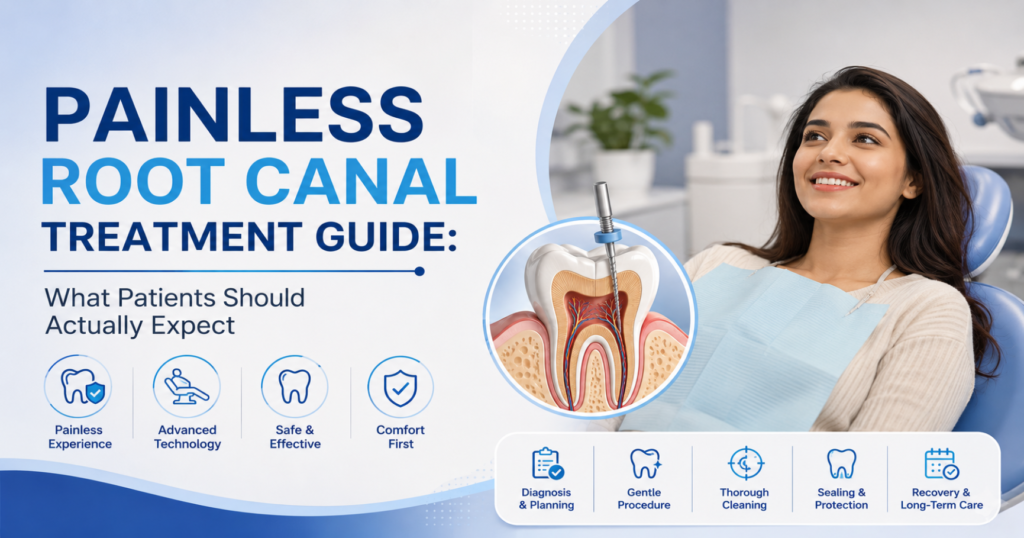
The words “root canal” are enough to make many people nervous.
Some patients associate root canal treatment with severe pain, long appointments and an uncomfortable recovery. But modern root canal treatment is very different from the frightening stories many people hear.
In fact, the purpose of root canal treatment is often to remove the source of dental pain and save the natural tooth.
The American Association of Endodontists explains that modern anesthetics and pain-management techniques allow the vast majority of patients to remain comfortable during treatment. Some sensitivity or discomfort may occur for a few days afterward, particularly when there was already pain or infection.
So what actually happens during a root canal?
What Is Root Canal Treatment?
Inside every tooth is a soft tissue called the pulp, containing nerves and blood vessels.
When this tissue becomes inflamed or infected because of deep decay, cracks, trauma or repeated dental procedures, root canal treatment may be required.
During treatment, the infected or inflamed pulp is removed. The canals inside the tooth are cleaned, disinfected, shaped and sealed. The tooth is then restored to protect it and return it to function.
The objective isn’t simply to “do a root canal.”
The objective is to save a natural tooth that might otherwise need extraction.
Why Might You Need a Root Canal?
Some common reasons include:
- Deep dental decay
- A cracked or damaged tooth
- Trauma
- Repeated dental procedures
- Problems beneath an existing restoration
- Infection of the tooth’s pulp
Symptoms can include persistent toothache, sensitivity to hot or cold, pain when biting, swelling or tenderness around the tooth.
However, symptoms aren’t always obvious. A tooth can sometimes have significant internal damage without causing severe pain.
That’s why an examination is important if you have persistent dental symptoms.
Does Root Canal Treatment Hurt?
This is probably the biggest question patients have.
Modern root canal treatment is performed using local anesthesia to numb the tooth and surrounding area.
You may experience sensations such as pressure or movement during the procedure, but you shouldn’t assume that a root canal will be extremely painful simply because the tooth is infected.
The AAE states that most patients report being comfortable during root canal treatment with modern techniques and anesthetics.
In many cases, the pain that brought a patient to the dentist is actually caused by the inflamed or infected tooth, not by the root canal procedure itself.
What Happens During Root Canal Treatment?
Step 1: Examination
Your dentist evaluates the tooth and determines whether root canal treatment is appropriate.
Diagnostic imaging may be used to understand the tooth and surrounding structures.
Step 2: Local anesthesia
The affected tooth is numbed before treatment begins.
The goal is to make the procedure comfortable.
Step 3: Accessing the tooth
A small opening is made to reach the infected or inflamed pulp.
Step 4: Cleaning the canals
The damaged pulp is removed and the root canals are carefully cleaned and disinfected.
Step 5: Sealing
Once the canals have been appropriately treated, they are filled and sealed to reduce the risk of reinfection.
Step 6: Restoring the tooth
Depending on the condition of the tooth, a filling or crown may be recommended to restore strength and function.
What Should You Expect After a Root Canal?
It is normal for the treated tooth to feel different for a short period.
Some patients experience mild sensitivity or tenderness after treatment, particularly if the tooth was already inflamed or infected.
Following your dentist’s instructions is important.
You should also contact your dentist if pain or pressure persists or becomes significant rather than assuming it is normal. The AAE specifically recommends contacting the treating dental professional when pain lasts beyond the expected recovery period.
Why Saving Your Natural Tooth Matters
If a tooth can be predictably saved, preserving it has important advantages.
A natural tooth provides normal biting and chewing function and helps maintain the existing relationship between surrounding teeth.
The AAE notes that properly treated teeth can continue functioning for many years and, with appropriate care, may last a lifetime.
Extraction isn’t automatically the better alternative simply because a tooth is infected. Your dentist should determine whether the tooth can be saved before considering replacement options.
Root Canal Treatment in Bhandup West
If you’re searching for root canal treatment in Bhandup West, choosing a clinic should involve more than looking for the word “painless.”
Ask about the dentist’s experience, diagnostic process, treatment approach and how your individual case will be managed.
ASPA Dental Care Centre is based in Bhandup and provides comprehensive dental treatment. Its website highlights modern diagnostic and treatment technology, including 3D dental scanning, full-mouth digital X-rays and dental laser technology.
The clinic also features patient experiences describing comfortable and painless root canal treatment, although individual treatment experiences can naturally vary.
Don't Let Fear Delay Treatment
A painful tooth doesn’t necessarily mean a painful dental procedure.
Modern root canal treatment is designed to relieve infection and preserve the natural tooth, with local anesthesia and contemporary pain-management approaches helping patients remain comfortable during treatment.
If you have persistent tooth pain, sensitivity, swelling or pain while biting, don’t wait for the symptoms to become worse.
Looking for root canal treatment in Bhandup West? Contact us at ASPA Dental Care Centre for an evaluation and personalized treatment plan.
